
Your garage door remote stops working because the communication between the handheld transmitter and the opener’s receiver has broken down somewhere along the chain, whether that is a depleted battery, a lost program pairing, radio frequency interference, a damaged antenna, an engaged security lock, or a failing receiver board inside the motor unit. Every dead remote has a specific cause, and identifying the right one is what separates a five-second fix from an unnecessary service call.
For homeowners across Durham, NC, a non-responsive remote is one of the most common garage door complaints technicians receive. The frustrating part is that the door itself often works perfectly fine. The motor runs, the springs are intact, the opener is operational. Something has simply disrupted the conversation between the remote in your hand and the receiver mounted on the ceiling of your garage. This guide walks through every cause behind that disruption, from the simplest to the most complex, and explains exactly what a professional technician does when self-troubleshooting does not resolve the problem.
How a Garage Door Remote Actually Works
Before diagnosing what went wrong, it helps to understand the basic communication system involved. A garage door remote is a radio frequency transmitter. When you press the button, it sends a signal encoded at a specific frequency, typically somewhere between 300 and 400 megahertz (MHz), most commonly 315 MHz or 390 MHz on modern residential systems. The motor unit hanging from your garage ceiling contains a receiver tuned to that frequency. When the receiver picks up the correct signal, it triggers the opener to run.
On older systems manufactured before the mid-2000s, this worked on a fixed code system, meaning the remote always sent the same encoded signal. On modern systems, including most LiftMaster, Chamberlain, Genie, and Craftsman openers sold today, rolling code technology (also marketed as Security+, Security+ 2.0, or Intellicode) generates a new unique code every single time the button is pressed. This prevents code theft but also means that if the remote and opener fall out of sync, reprogramming is necessary.
Understanding this communication framework matters because it clarifies why so many different things can prevent the remote from working. Any disruption to the signal, the transmitter, the receiver, or the programming connection breaks the chain.
The Most Common Reasons a Garage Door Remote Stops Working
1. Dead or Weak Batteries
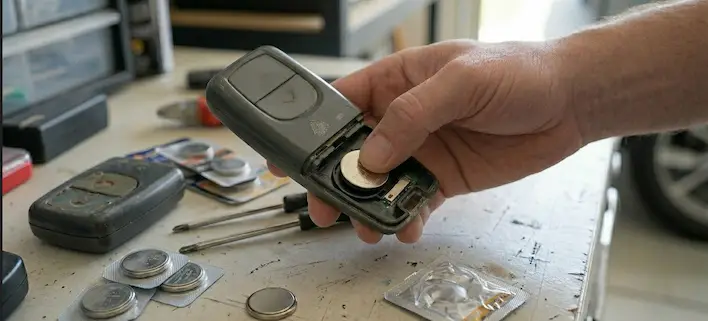
This is where every diagnosis should start, because it is the most common cause by a significant margin. Garage door remote batteries typically last about two years under normal use, but that timeline shortens considerably in extreme heat or cold. Durham‘s summer temperatures, particularly inside a vehicle where remotes are often stored, can drain batteries faster than homeowners expect. A remote left on a car dashboard or in a hot cupholder in July may need a battery replacement within a year of installation.
The diagnostic test is simple. If pressing the remote produces no LED indicator flash on the remote itself, the battery is almost certainly the problem. If the LED flashes but the door does not respond, the issue is elsewhere. Replacing the battery with a fresh one from a known reliable source, rather than a battery that has been sitting in a drawer, is the correct first step.
One detail worth knowing: some remotes display the same LED flash on a weak battery as they do on a fresh one, which makes the LED test unreliable in certain cases. If the remote only works when you hold it very close to the motor unit, that reduced range is often the first sign that the battery is nearing the end of its life even if the indicator light looks normal.
2. The Remote Has Lost Its Programming
Garage door openers store the codes for paired remotes in their internal memory. Several events can clear that memory and unpair every remote simultaneously: a power outage, a power surge from one of Durham’s frequent summer thunderstorms, someone accidentally pressing and holding the learn button on the motor unit, or simply battery depletion in the opener’s backup system on units that have one.
When a remote loses its pairing, it sends a signal the opener no longer recognizes. The motor does not respond at all. The wall-mounted button, if it is hardwired to the opener rather than operating wirelessly, typically continues to work because it does not rely on the stored code system.
Reprogramming a remote requires locating the learn button on the motor unit, pressing it to enter pairing mode, and then pressing the desired button on the remote within thirty seconds. The exact steps vary slightly by brand, but this general process applies to virtually every modern opener on the market. The learn button is usually found on the back or side of the motor unit, sometimes behind the light cover panel, and is often color-coded: yellow or purple on LiftMaster and Chamberlain models, and a round button near the terminal strip on Genie units.
After a successful pairing, the opener’s indicator light blinks or two audible clicks confirm that the code has been stored.
3. Radio Frequency Interference from Nearby Devices
This is the cause that most surprises homeowners, because the problem can appear without anything changing in the garage itself. Radio frequency (RF) interference occurs when another electronic device in or near the garage emits electromagnetic noise on a frequency close enough to the opener’s operating frequency to disrupt the signal. The remote sends its transmission, the interference drowns it out, and the receiver never registers the command.
The most widely reported and documented source of this interference is LED light bulbs, including bulbs installed inside the opener unit itself. Many inexpensive or unshielded LED bulbs emit RF noise that falls directly within the 300 to 400 MHz range that garage door remotes use. Homeowners often report that their remote stopped working shortly after installing new LED lighting in the garage, or that the remote works when the garage lights are off but fails when they are on. Replacing the problematic bulbs with LED bulbs specifically labeled as “garage door opener compatible” or “RF-shielded” resolves this immediately in most cases.
Other sources of interference include wireless routers, baby monitors, wireless security cameras, smart home hubs, and in some cases neighboring garage door openers operating on overlapping frequencies. Durham’s growing concentration of smart home technology in neighborhoods from Woodcroft to Trinity Park means that RF interference from household electronics is a more common cause of remote problems than it was a decade ago.
Environmental interference from natural sources also occurs. Durham’s active thunderstorm season introduces electromagnetic noise during and immediately after storms. If your remote suddenly stopped working after a storm, signal disruption from the weather event combined with a potential power surge affecting the opener’s memory are both worth investigating.
If all remotes stop working simultaneously while the wall button continues to function normally, RF interference or a programming memory reset are the two most likely explanations, since individual remote failures tend to happen one at a time.
4. The Security Lock Feature Is Engaged
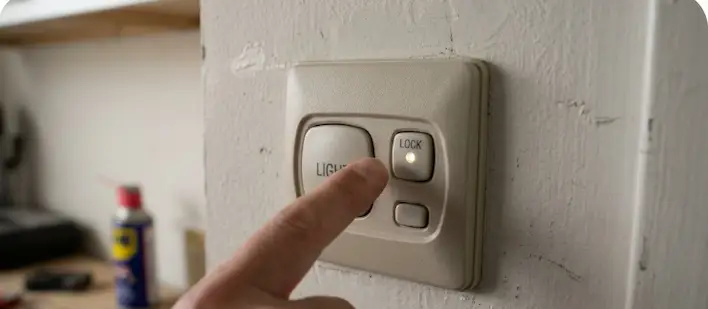
Garage door openers include a security lock mode, sometimes labeled as a vacation lock or lock mode, that disables all remote communication and allows the door to be operated only from the wall-mounted control panel inside the garage. This feature exists to prevent entry while homeowners are away for extended periods. It is activated and deactivated by pressing the lock button on the wall panel.
If this mode gets engaged accidentally, which happens more often than one might expect given that the lock button and the light button are often adjacent on the wall panel, every remote in the house will stop working immediately. The door appears completely unresponsive to remote commands, but the wall button works without any issue.
Checking the wall panel for an illuminated lock indicator and pressing the lock button once to disengage it takes about ten seconds. For homeowners who have never encountered this feature before, the experience of a suddenly unresponsive remote with a perfectly functional wall button can feel like a significant malfunction when the reality is one button press away from resolution.
5. The Opener’s Antenna Is Damaged or Mispositioned
The motor unit’s antenna is what receives the signal from your remote. On most residential openers, this is a thin wire that hangs down from the motor housing. If this wire is bent upward against the unit, coiled, pinched behind a bracket, covered with debris or cobwebs, or physically damaged, the opener’s ability to receive remote signals from normal distances drops significantly. In some cases, reception becomes so poor that the remote only works when held within a few feet of the motor unit.
Inspecting the antenna takes a moment. The wire should hang straight down from the motor unit, free of obstructions, and show no visible fraying, cracking, or cuts. Straightening a bent antenna wire and clearing any debris from around the receiver housing often restores full range immediately. If the antenna wire is physically broken or the receiver port on the motor unit is damaged, a professional repair or receiver replacement is needed.
In Durham garages, particularly detached garages and older attached garages with limited sealing, insects and spiders regularly build nests around and inside garage door motor housings. A spider web across the antenna wire or inside the receiver housing can reduce signal reception noticeably. This is an easy thing to clean but an easy thing to overlook during troubleshooting.
6. The Remote Itself Has Physical Damage
Garage door remotes live hard lives. They get dropped on driveways, sat on in car seats, left in direct sun on dashboards, soaked in rainstorms when someone forgets they are in a jacket pocket, and run through the washing machine more times than anyone wants to admit. Any of these events can crack the internal circuit board, break the connection between the battery contacts and the circuit, warp the case so the button no longer makes proper contact, or corrode the internal components.
A remote with physical damage may still show an LED flash when pressed because the basic circuit still functions, but the transmitter coil may not be sending a signal strong enough to reach the receiver at normal range. Testing by holding the remote directly against the motor unit eliminates range as a variable. If the door still does not respond from that distance with fresh batteries installed, the remote’s internal transmitter is likely the problem.
Replacement remotes are available as OEM units from the opener manufacturer or as compatible universal remotes from hardware stores. Universal remotes are compatible with most major brands and generations, but it is worth verifying compatibility with your specific opener model before purchasing. A technician can confirm compatibility and program the replacement in minutes.
7. Receiver Board Failure in the Motor Unit
When fresh batteries, reprogramming, antenna inspection, and interference elimination have all failed to restore remote function, and the wall button continues to operate the door normally, the receiver board inside the motor unit becomes the likely suspect. The receiver board is the component inside the opener that actually processes incoming remote signals. When it fails, partially or completely, the opener becomes unresponsive to all remote commands regardless of how many remotes are paired or what frequency they transmit.
Receiver board failure can result from power surge damage, age-related component degradation, moisture intrusion into the motor housing, or physical damage. This is not something that can be diagnosed or repaired by visual inspection alone. A technician uses diagnostic procedures to confirm that the board is the source of the problem rather than an overlooked simpler cause.
Depending on the opener’s age and model, the repair involves either replacing the receiver board or replacing the logic board that integrates both the receiver and the control functions. On older openers that are already near the end of their service life, the cost-benefit analysis of board replacement versus full opener replacement is worth discussing with the technician during the service call.
8. The Opener Has Lost Power or Tripped a Circuit
If no controls work at all, not the remote, not the wall button, and the opener’s indicator lights are off, the problem is not with the remote. The opener has lost power. This can result from a tripped circuit breaker, a blown GFCI outlet (which garage circuits in North Carolina homes are typically required to use), or a disconnected power cord.
Checking the breaker panel for a tripped circuit and pressing the reset button on the GFCI outlet in the garage or on a nearby outlet that shares the circuit addresses this quickly. If power is restored and the wall button works but the remote does not, the diagnostic returns to the remote-specific causes above.
What Durham NC Repair Technicians Do When Self-Troubleshooting Falls Short
Many remote problems are resolved through the steps above without professional involvement. But when they are not, the pattern of failure becomes more important. A technician approaching this problem thinks through the diagnostic systematically using a few critical questions.
Does the wall button work? If yes, the opener itself is functional and the problem is with the remote signal chain. If no, the investigation expands to the opener’s power supply, motor, and control board.
Do all remotes fail simultaneously or just one? Simultaneous failure of multiple remotes with a functional wall button points strongly to a programming memory reset, the security lock feature, or RF interference. A single remote failing while others work points to that specific remote’s battery, internal components, or programming loss.
Does the remote work from very close range but not from the driveway? This points to signal strength issues, most commonly antenna damage, RF interference, or a weak battery.
Does the failure coincide with a specific event, such as a power outage, new electronics installed in the garage, or recent thunderstorm activity? This narrows the field significantly toward either programming loss or interference.
Once the technician has established which part of the communication chain has failed, the repair is targeted. Battery and programming issues require no parts. Antenna damage may require a new antenna wire or receiver module. Interference requires identifying and eliminating the source, which sometimes involves installing an antenna extension that relocates the receiver to a position with better signal clarity, or upgrading older fixed-code opener systems to modern rolling-code technology. Receiver or logic board failure involves sourcing and installing compatible components or recommending a full opener replacement if the unit is old enough that replacement makes more financial sense than repair.
When an opener is replaced, the technician programs all remotes and keypads to the new unit before completing the call, confirms range and responsiveness from the driveway and through multiple close cycles, and tests the wall button and any interior keypads to confirm everything communicates correctly.
Durham-Specific Factors That Make Remote Problems More Common
Homeowners in Durham encounter a few conditions that make remote failures more likely than the national average suggests.
The Research Triangle’s growing density of smart home devices, Wi-Fi networks, and wireless security systems increases the RF noise environment in residential garages. A neighborhood that had relatively clean radio frequency conditions five years ago may now have multiple overlapping wireless signals from neighboring smart home systems that create intermittent interference for older opener receiver systems.
Durham’s summer thunderstorm season creates both physical power surge risks for opener electronics and temporary electromagnetic interference from lightning activity. Surge protectors on garage outlets provide meaningful protection for opener circuit boards and memory.
The area’s heat and humidity accelerate battery drain in remotes stored in vehicles. A remote that lasts two years in a climate-controlled environment may need a battery replacement closer to every twelve to fourteen months when the remote spends summer days in a hot car in Durham.
Durham’s proximity to Research Triangle Park and the area’s concentration of industrial and research facilities means that some residential areas are more exposed to radio frequency activity from nearby commercial operations, which can contribute to the range reduction and intermittent performance issues that homeowners often attribute to remote failure rather than environmental interference.
When It Makes More Sense to Upgrade Than to Repair
Garage door openers manufactured before approximately 2005 often use fixed-code technology that presents both functional and security limitations. Fixed-code systems are more vulnerable to interference from neighboring openers operating on the same code, and the technology is genuinely less secure than modern rolling-code systems because the transmitted code can theoretically be captured and replicated.
If your opener is more than fifteen years old and is experiencing recurring remote issues, the conversation about upgrading to a modern system is worth having. Current opener models from LiftMaster, Chamberlain, Genie, and Craftsman offer Security+ 2.0 or equivalent rolling-code technology, integrated LED lighting designed to avoid RF interference, smartphone connectivity through platforms like myQ that allow remote operation via an app regardless of where you are, and battery backup systems that keep the door operational during Durham’s occasional power outages.
The cost of repeated remote repairs and receiver component replacements on an aging system can approach or exceed the cost of a new opener installation within a relatively short period. A technician can provide a comparison that makes this decision straightforward.
Maintenance Habits That Protect Your Remote System
Replacing remote batteries annually as a preventive measure rather than waiting for failure eliminates one of the most common causes of unexpected remote problems. Keeping a spare battery in the glove compartment means that even when a battery dies at an inconvenient moment, the fix takes thirty seconds.
Storing remotes away from direct sun exposure inside vehicles reduces heat-related battery drain and protects the internal circuit board from temperature-related warping. A remote stored in a center console or door pocket rather than clipped to a sun visor experiences meaningfully lower peak temperatures during Durham summers.
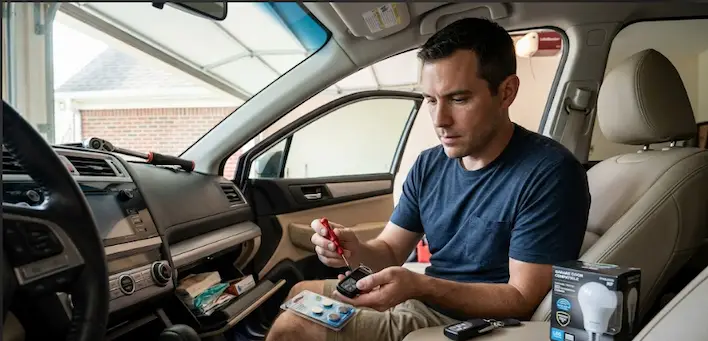
When adding new LED lighting to the garage, choosing bulbs specifically rated as compatible with garage door openers eliminates the risk of introducing RF interference. The packaging on these bulbs typically notes that they are shielded for use near wireless control systems.
A professional tune-up that includes opener inspection, receiver verification, and antenna condition check once a year catches developing problems before they become full remote failures. Technicians serving Durham homes recommend annual service for most residential systems, with twice-yearly service for garages used as primary home entry points where the door cycles many times each day.
Frequently Asked Questions
Why do all my remotes stop working at the same time? When every remote fails simultaneously while the wall button continues to work, the most common explanations are a programming memory reset from a power outage or surge, the security lock being engaged on the wall panel, or RF interference affecting all wireless signals equally. A technician can identify which is responsible within minutes of inspection.
My remote only works when I stand right next to the opener. What does that mean? Very short range with an otherwise functioning remote points to either a weak battery, a damaged or misdirected antenna on the motor unit, or RF interference reducing the effective signal distance. Replacing the battery and checking the antenna orientation are the first steps.
Can a power outage cause my remote to stop working? Yes. Power outages and surges can reset the opener’s internal memory, erasing all paired remote codes. After power is restored, remotes need to be reprogrammed using the learn button on the motor unit. On some models, a battery backup maintains the code memory through brief outages, but extended power loss typically clears it.
My garage door opens fine with the wall button but the remote does nothing. Where is the problem? Since the wall button works, the opener motor and mechanism are functioning correctly. The problem is isolated to either the remote’s battery or internal components, the programming pairing, an engaged security lock, RF interference, or the opener’s receiver board. Working through these causes in order from simplest to most complex resolves the issue in most cases.
Can LED bulbs in my garage really affect my remote? Yes, and this is more common than most homeowners realize. Certain unshielded LED bulbs emit radio frequency noise that interferes directly with the operating frequency range of garage door remotes. If your remote problems began around the time new lighting was installed, swapping those bulbs for opener-compatible, RF-shielded LED bulbs is the first thing to try.
How do I know when to replace the remote versus having the opener repaired? If the problem is isolated to one remote and the unit shows physical damage, buttons that no longer respond properly, or fails to communicate even from inches away with a fresh battery, replacement is the practical choice. If multiple remotes fail simultaneously or the remote appears functional but the opener does not respond, the investigation should focus on the opener’s receiver system rather than the remote itself.
A garage door remote that stops working is almost always telling you something specific, whether it is that a battery has run its course, a programming connection was lost to a power event, RF interference has crept into the signal environment, or an internal component has reached the end of its service life. For Durham, NC homeowners, the local climate and the Triangle’s growing wireless device density add their own layer of context to each of these causes. A knowledgeable technician who understands both the communication systems involved and the conditions specific to this area can diagnose the real cause accurately and restore reliable remote operation, so the next time you pull into your driveway, pressing that button works exactly the way it should.